
Table of Contents
- Understanding Prior Authorization for Addiction Treatment
- Fundamentals of Prior Authorization for Addiction Treatment
- Deep Dive Into Prior Authorization: Clinical Documentation, Denials, and Appeals
- Practical Guide to Obtaining Prior Authorization for Addiction Treatment
- Advanced Considerations in Prior Authorization for Addiction Treatment
- Frequently Asked Questions About Prior Authorization for Addiction Treatment
- Take the Next Step Toward Treatment
Understanding Prior Authorization for Addiction Treatment
Prior authorization for addiction treatment is a pre-approval from your insurance company required before starting outpatient services like IOP or PHP. It verifies that the treatment is medically necessary and covered under your plan. This step helps protect both you and the insurer by confirming the recommended level of care matches your clinical needs.
While prior authorization focuses on confirming medical necessity, it works alongside insurance verification for rehab. When looking at options, choosing accredited rehab centers that accept insurance can smooth the process; facilities with Joint Commission accreditation, like Recovery Cove, often experience faster prior authorization because insurers trust their high standards. The verification of benefits (VOB) is a parallel step that details your plan’s deductibles and copays, while prior authorization confirms coverage for the specific treatment.
At Recovery Cove, we handle all prior authorization paperwork to reduce your stress. Our admissions team contacts your insurer on your behalf, submits clinical documentation, and keeps you informed throughout. As a provider based in Pennsylvania, we are familiar with regional insurance requirements. You don’t need to navigate this process alone. In the next section, we walk you through exactly how we manage prior authorization so you can focus on recovery.
Prior authorization requirements vary by insurance plan; contact your provider for specific details.
Now that you understand your insurance coverage, let’s cover the fundamentals of prior authorization — a key step before starting treatment. Prior authorization, sometimes called precertification, is the pre-approval process that insurance companies use to determine the medical necessity of addiction treatment before it begins. This evaluation helps confirm that the recommended level of care is clinically appropriate and protects you from unexpected costs. It is most common for partial hospitalization programs (PHP), frequently required for intensive outpatient (IOP), and sometimes needed for traditional outpatient (OP). If you’re looking for accredited rehab centers that accept insurance, our insurance verification page can help you get started.
The following table summarizes typical prior authorization requirements across these outpatient levels of care.
| Requirement Aspect | Partial Hospitalization (PHP) | Intensive Outpatient (IOP) | Outpatient (OP) |
|---|---|---|---|
| Typical Prior Auth Required? | Almost always required | Often required | Sometimes required |
| Common Sessions/Week | 5–7 days, 4–6 hours/day | 3–5 days, 3 hours/day | 1–2 days, 1 hour/day |
| Clinical Documentation Needed | Detailed assessment, treatment plan, DSM-5 criteria | Assessment, less detail than PHP | Basic assessment and treatment plan |
To obtain prior authorization, insurers typically require a set of clinical documents, including a DSM-5 diagnosis, a comprehensive treatment plan, a medical necessity letter, and results from a clinical assessment. Our licensed clinicians at Recovery Cove compile these materials as part of your initial evaluation, ensuring your submission is as complete as possible.
Based on SAMHSA’s TIP 45 guidelines for level-of-care criteria, the intensity and structure of each program dictate the depth of documentation needed. PHP, as the most intensive outpatient option, demands a thorough clinical package to justify the higher level of structured daily care. IOP documentation is still substantial but less exhaustive, while routine outpatient services typically rely on a basic clinical assessment and a straightforward treatment plan.
Our team at Recovery Cove helps you navigate this documentation process seamlessly. During a free, confidential insurance verification for rehab, we perform a verification of benefits (VOB) in Pennsylvania, confirming your coverage details, deductibles, and any coinsurance responsibilities. This step clarifies what your plan requires and positions us to gather the necessary paperwork on your behalf. For a more detailed walkthrough on checking your benefits, our FAQ on insurance verification provides step-by-step guidance on contacting your insurer and understanding your plan.
Because prior authorization requirements vary by insurance plan and state regulations, we can’t guarantee approval, but our experienced admissions staff is here to support you each step of the way. With the basics of prior authorization covered, the next section walks you through how to actually apply for authorization and what to expect.
Information on this site is not a substitute for professional medical advice.
Deep Dive Into Prior Authorization: Clinical Documentation, Denials, and Appeals
Navigating prior authorization for addiction treatment in Easton, PA can feel overwhelming, but understanding the documentation and processes involved makes it far more manageable. At Recovery Cove, we walk you through every step, ensuring your clinical records are complete and accurate. This section breaks down the core documents, common reasons for denial, and the steps of the appeals process—including what you need to know about medication-assisted treatment (MAT). Please note: this information is educational; always consult a healthcare professional for diagnosis and treatment recommendations.
Required Clinical Documentation
Thorough clinical documentation forms the backbone of any successful prior authorization request. Insurers require a specific set of documents to evaluate medical necessity for addiction treatment. The following table, aligned with guidelines from SAMHSA behavioral health resources and ASAM criteria, outlines the essential clinical documents and who typically prepares them.
| Document Type | Purpose | Typical Contents | Who Prepares |
|---|---|---|---|
| Initial Assessment / Bio-Psychosocial | Comprehensive evaluation of patient history and needs | Substance use history, mental health, medical, social support, DSM-5 criteria | Licensed clinician at treatment center |
| Treatment Plan | Outline of proposed services, goals, and discharge criteria | Level of care, weekly schedule, therapy modalities, discharge criteria | Treatment team (clinical director, case manager) |
| Medical Necessity Letter | Clinical justification for the requested level of care | Summary of diagnosis, functional impairments, risk of relapse, why lower levels insufficient | Physician or clinical director |
| Progress Notes (if applicable) | Evidence of engagement and response to treatment | Attendance, participation, progress toward goals, any setbacks | Primary therapist / counselor |
Each of these documents plays a distinct role. The initial assessment captures the full picture of an individual’s substance use, mental health, and social support systems, while the treatment plan maps out the path forward. The medical necessity letter provides the clinical rationale that justifies why an intensive outpatient or partial hospitalization level of care is required. Progress notes, when available, demonstrate engagement and response to treatment. At Recovery Cove, our licensed clinicians prepare these documents meticulously, pulling from thorough evaluations and individualized plans. Before we ever submit a prior authorization request, our admissions team completes a verification of benefits (VOB) and runs insurance verification for rehab in Lehigh Valley so we can align your treatment with your coverage. This proactive approach minimizes delays and strengthens the overall authorization package.
What Happens When Prior Authorization Is Denied
Even with comprehensive documentation, prior authorization requests can be denied. The most common reasons include a determination of lack of medical necessity, incomplete or missing information, and an incorrect level of care requested. If you receive a denial, the process is not over—there are clear steps to appeal the decision.
First, you can request a reconsideration, which allows the insurer to review the original decision in light of additional context. Next, we help you submit supplemental documentation—often a revised medical necessity letter or updated progress notes—to address the specific reason for the denial. Involving the treating physician directly can add weight to the appeal by providing further clinical perspective. If the insurer still upholds the denial, you may have the right to an external review by an independent third party.
Recovery Cove supports you throughout the entire appeal. Our team assists with drafting appeal letters, gathering supporting evidence, and coordinating communication with the insurance company. In many cases, a well-prepared appeal can reverse an initial denial. Sometimes denials arise from errors in the insurance verification for rehab in Lehigh Valley or an incomplete verification of benefits (VOB); our staff double-checks these details before resubmission.
Prior Authorization for Medication-Assisted Treatment (MAT)
Prior authorization for medication-assisted treatment (MAT)—including medications like buprenorphine (Suboxone®) and naltrexone (Vivitrol®)—follows many of the same principles but often carries additional requirements. Insurers may request proof of diagnosis of opioid use disorder, documentation of previous treatment attempts, or a plan for regular monitoring and follow-up.
At Recovery Cove, our medical and clinical teams work together to compile the necessary records. We detail the medical necessity for MAT as part of a whole-person treatment approach, showing how medication, when combined with therapy and support, addresses both cravings and the underlying causes of addiction. We also verify that the specific formulation (oral, injectable) is covered under your plan and handle any dosage or frequency requirements set by the insurer.
Our team helps you navigate these nuances so you can focus on your recovery. By integrating MAT prior authorization into the same thorough process we use for all levels of care, we reduce administrative roadblocks and keep your treatment on track.
Now that you understand the prior authorization process and how thorough documentation, denial appeals, and MAT coordination work together, the next section explains how Recovery Cove verifies your insurance and handles the verification of benefits to get your treatment started as quickly as possible.
Practical Guide to Obtaining Prior Authorization for Addiction Treatment
Once you know your coverage, the next critical step is obtaining prior authorization. Navigating prior authorization for addiction treatment can feel daunting, but Recovery Cove is here to guide you each step of the way. Here’s a practical, four-step process to secure approval and begin your recovery journey.
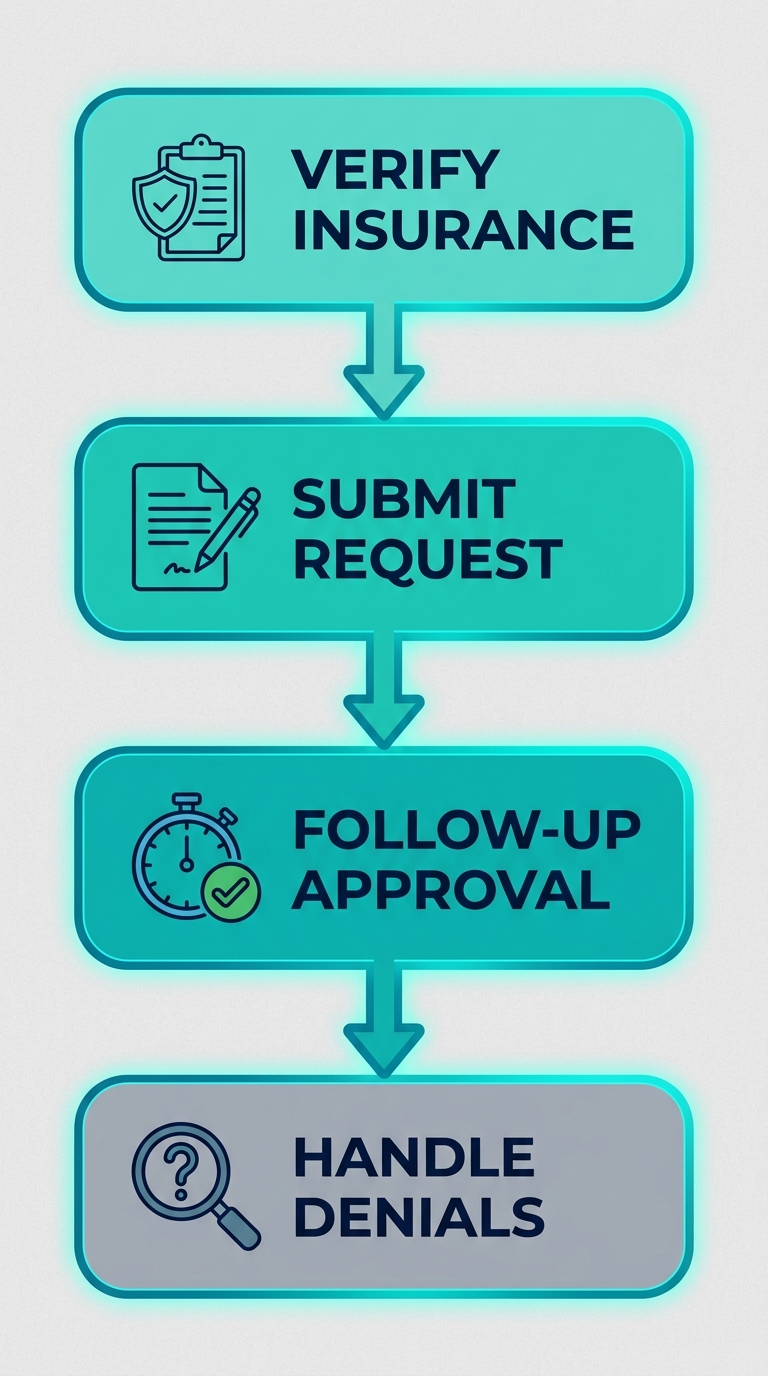
Four-step prior authorization workflow for addiction treatment
Step 1: Verify Your Insurance and Prior Authorization Needs
The first task is to confirm your benefits and any prior authorization requirements. You can call your insurance company directly, or let our team handle the insurance verification for rehab at no charge. We’ll ask for your policy ID, group number, member name, date of birth, and the relevant diagnosis code. This information lets us check your plan’s coverage for outpatient services and determine whether prior authorization is needed. For clients in Easton, PA and across the Lehigh Valley, our admissions staff performs this verification in 24 to 48 hours, so you can move forward with confidence.
Step 2: Submission of Prior Authorization Request
After completing the verification of benefits (VOB), our admissions team submits the prior authorization request for addiction treatment directly to your insurer. We prepare a comprehensive clinical packet that includes your assessment, an individualized treatment plan, and a letter of medical necessity. The submission is done electronically to speed the process. Standard requests typically receive a decision within 24 to 72 hours, while urgent cases can be approved same-day or the next day. Having Recovery Cove manage this step means you avoid the hassle of faxing documents and following up on your own.
Step 3: Follow-Up and Approval
Once the request is submitted, we track its progress and keep you updated. Most approvals arrive quickly, but response times can vary by insurer. We recommend you keep a record of your authorization number and the effective dates so you’re prepared for your intake. If any additional information is needed, our team will coordinate directly with the insurance company. Our goal is to make the prior authorization process for addiction treatment as seamless as possible so you can focus on what matters—your recovery.
Step 4: Handling Denials and Maximizing Success
If your prior authorization is denied, don’t lose hope. The notice will explain the reason—often it’s missing documentation or a question of medical necessity. Our advocacy team will review the denial and help you gather additional supporting documents, such as progress notes or a second opinion letter, then submit a formal appeal. You are not alone and this is not the end of your story. To improve your chances from the start, ensure all submitted data is accurate, use in-network providers, and maintain open communication with our billing department. While we cannot guarantee approval, working with an experienced team significantly increases the likelihood of a successful outcome.
The table below compares the experience of obtaining prior authorization with Recovery Cove’s help versus handling it on your own.
| Aspect | With Recovery Cove’s Assistance | Doing It Yourself |
|---|---|---|
| Insurance Verification | Team verifies benefits and checks prior auth requirements | You call insurance, provide policy info, wait on hold |
| Documentation Preparation | Clinical team assembles assessment, treatment plan, medical necessity letter | You coordinate with your own provider to get documents |
| Submission | Submitted electronically by dedicated admissions staff | You fax or upload documents, follow up on status |
| Handling Denials | Team appeals on your behalf with additional documentation | You must understand the denial reason and gather appeal docs |
| Likelihood of Approval | Higher due to experienced team and in-network relationships | Varies; may be lower if documents are incomplete |
With your prior authorization in hand, you’re ready to begin treatment. Contact us to schedule your intake assessment. Heal. Grow. Connect. Live. Your path to recovery starts here. Please note that results vary, and this content is not a substitute for professional medical advice. Always consult a healthcare professional for diagnosis and treatment recommendations.
Advanced Considerations in Prior Authorization for Addiction Treatment
Building on the basics, let’s explore some advanced scenarios you may encounter. The prior authorization for addiction treatment process doesn’t always go smoothly. Denials, out-of-network roadblocks, and the complexities of co-occurring disorders often surface, demanding a deeper understanding of insurance appeals, state regulations, and strategic planning. In this section, we’ll cover what to do when your claim is denied, how to navigate out-of-network benefits, and why a comprehensive dual-diagnosis plan can bolster your request. We’ll also share how requesting a single-case agreement can open doors to care outside your network, and how our financial counselors guide you through every step.
Denials are not the end of the road. You can appeal a denied prior authorization for addiction treatment by submitting a letter of medical necessity, clinical records, and proof of medical stability within the insurer’s deadline, often 30 days. We work with your clinical team to assemble a compelling narrative that highlights medical necessity. Although the initial pre-authorization for intensive outpatient programs is typically processed within a few days, an appeal may extend the timeline. In-network providers benefit from streamlined prior authorization, but for out-of-network care, requesting a single-case agreement is a powerful next step. During this period, we complete a verification of benefits (VOB) — also referred to as insurance verification for rehab — so you know exactly which services are covered. At Recovery Cove, our holistic dual-diagnosis approach not only improves recovery outcomes but also strengthens the payer authorization for behavioral health treatment by demonstrating that co-occurring mental health conditions require integrated care. In Pennsylvania, parity laws mandate that insurers cover mental health and substance use treatment equally, giving your appeal added legal weight. Our financial counselors guide you through these complexities, and while we advocate persistently, results may vary depending on your plan.
Navigating advanced prior authorization challenges can feel overwhelming, but you don’t have to do it alone. Our team is dedicated to helping you understand your coverage and appeal denials so you can focus on what matters most: your healing journey. Remember, you are not alone and this is not the end of your story. We’ll stand with you throughout the insurance approval process for addiction rehab, from initial verification to final resolution.
Frequently Asked Questions About Prior Authorization for Addiction Treatment
Here are answers to frequently asked questions about prior authorization for addiction treatment at Recovery Cove.
Q: What is prior authorization for addiction treatment? A: Prior authorization for addiction treatment is a pre-approval required by your insurance to ensure services are medically necessary and covered, helping you avoid surprise bills.
Q: How does Recovery Cove help with insurance verification? A: We handle insurance verification for rehab and the verification of benefits (VOB) process at no cost. Have your insurance card ready, and we’ll take it from there.
Q: What if my insurance doesn’t cover treatment? A: Coverage depends on your plan. If treatment isn’t covered, we can help explore alternatives and can point you to resources like the SAMHSA treatment locator.
For a personalized estimate of your coverage, contact our team to verify your benefits—no obligation.
Please note: Results may vary; coverage is determined by your insurance provider. Information on this site is not a substitute for professional medical advice. Consult a healthcare professional for diagnosis and treatment recommendations.
Take the Next Step Toward Treatment
Taking the first step can feel overwhelming, but we are here to help. Our team simplifies prior authorization for addiction treatment and handles insurance verification for rehab, including verification of benefits (VOB), so you can focus on healing. Call us at 484-549-2683 for a confidential benefits check. Even without insurance, treatment is possible — visit our FAQ to explore your options. You are not alone and this is not the end of your story. Contact our team today to learn more about our accredited rehab centers that accept insurance.





