Table of Contents
- Understanding Trauma-Informed Outpatient Care in Easton, Pennsylvania
- Trauma-Informed Care Options Across the Lehigh Valley
- Modalities and Programs Available for Trauma-Focused Recovery
- Local Factors That Shape Trauma-Informed Care in Easton
- Starting Your Journey with Trauma-Informed Outpatient Care
- Healing Through Trauma-Informed Support
Understanding Trauma-Informed Outpatient Care in Easton, Pennsylvania
Trauma informed outpatient care is a treatment philosophy where every member of our team recognizes and responds to the impact of trauma. It moves beyond simply asking “What’s wrong?” to understanding “What happened to you?” This approach creates a safe, supportive environment designed to promote healing without re-traumatization.
At Recovery Cove in Easton, Pennsylvania, we integrate this philosophy into our flexible outpatient programs, blending trauma-focused therapy like CBT and EMDR therapy for addiction into a holistic approach. We believe in treating the whole person, not just the symptoms. Our dual-diagnosis program integrates trauma-informed care dual diagnosis principles to treat both addiction and underlying trauma. According to the Substance Abuse and Mental Health Services Administration, this model is built on core principles of safety, trustworthiness, and empowerment. Results may vary, but this evidence-based foundation offers a compassionate path to recovery.
Trauma-Informed Care Options Across the Lehigh Valley
To help you find the right fit for your healing journey, we offer multiple levels of trauma informed outpatient care in the Lehigh Valley. As shown in the table below, each level of care varies in time commitment and therapeutic focus so you can step into the support that best matches your current needs.
| Level of Care | Time Commitment | Therapy Focus | Ideal For |
|---|---|---|---|
| PHP | 20+ hours per week | Intensive trauma processing, daily individual and group therapy | Clients needing stabilization but not 24/7 supervision |
| IOP | 9-12 hours per week | Trauma-focused group and individual sessions, skill building | Clients transitioning from PHP or starting outpatient trauma work |
| Outpatient | 1-2 hours per week | Ongoing trauma processing, relapse prevention, maintenance | Sustained recovery, step-down from IOP |
Our Partial Hospitalization Program provides more than 20 hours of structured support each week for clients who need intensive trauma processing without round-the-clock supervision. Therapy focus includes trauma-focused therapy such as EMDR therapy for addiction, daily individual sessions, and group work that builds a strong foundation for stabilization.
The Intensive Outpatient Program is a flexible next step that offers 9 to 12 hours of weekly programming. Here we combine skill-building groups with individual trauma-focused therapy, often continuing modalities like EMDR therapy for addiction to help you process underlying pain while maintaining work or family commitments.
For sustained recovery, traditional outpatient care delivers one to two hours of weekly therapy centered on relapse prevention and ongoing processing. This level works well as a step-down from IOP or as a starting point for individuals who need consistent, lower-intensity support.
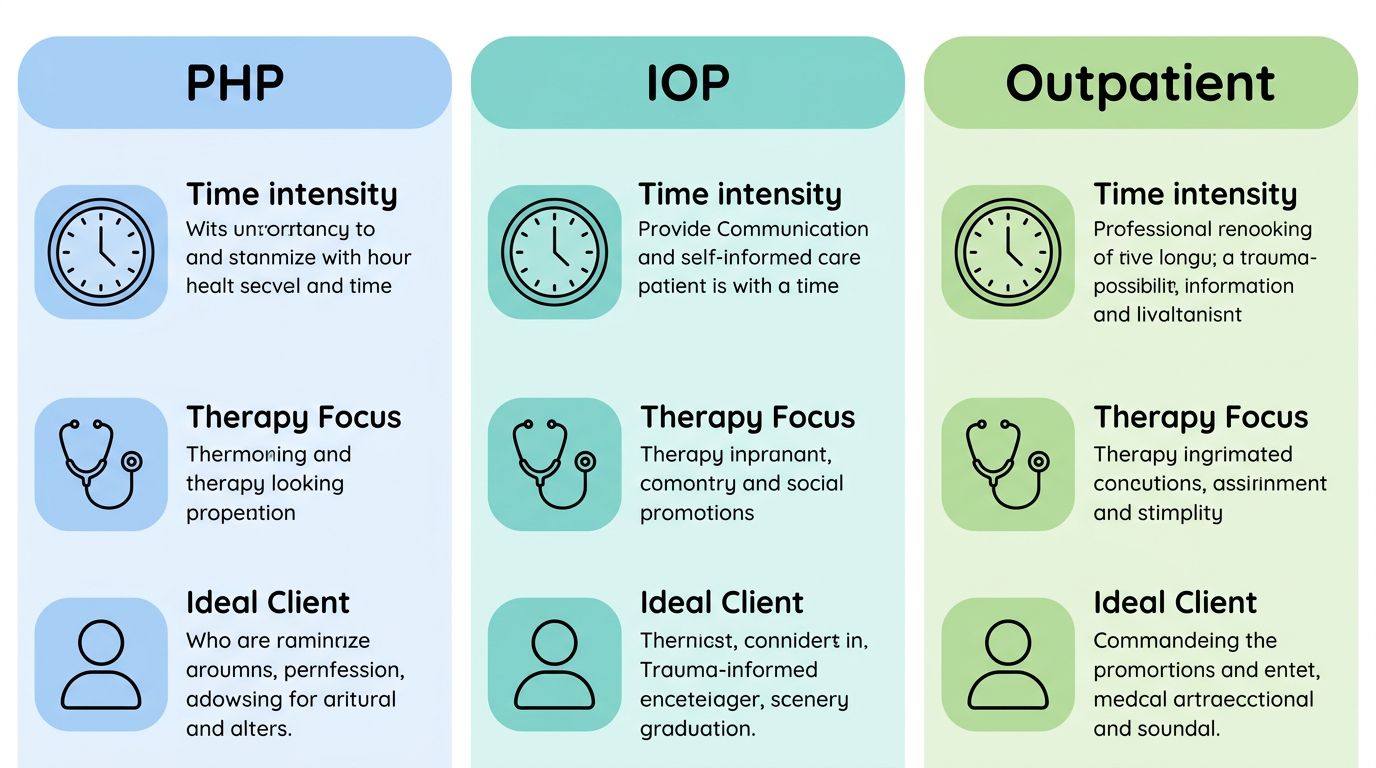
Trauma-informed care options: PHP, IOP, and outpatient at a glance.
We believe in treating the whole person with evidence-based, holistic options that honor where you are today. For a broader view of available programs in the state, you can use a rehab center locator in Pennsylvania. In the next section, we’ll explore the therapeutic approaches used within each level of care.
Results may vary. Consult a healthcare professional for diagnosis and treatment recommendations.
Modalities and Programs Available for Trauma-Focused Recovery
To support your journey, we offer a range of modalities and program levels that embody trauma informed outpatient care. At Recovery Cove in Easton, Pennsylvania, we integrate evidence-based therapies with a compassionate, holistic philosophy so you can heal in a safe and supportive environment.
Our trauma-focused therapy options include EMDR therapy for addiction, an approach that helps you process traumatic memories, and trauma-focused cognitive behavioral therapy (CBT) to reframe unhelpful thought patterns. These modalities are delivered within flexible outpatient levels of care: Partial Hospitalization Program (PHP), Intensive Outpatient Program (IOP), and individual therapy. We coordinate care across program levels so you can step between intensities as needed, and we offer telehealth and virtual IOP options to improve access and continuity throughout treatment. Group therapy and dual-diagnosis support are also available for those managing co-occurring conditions, ensuring your whole-person wellness remains at the center of your recovery. This trauma informed outpatient care model respects your daily life with evening and flexible scheduling.
Every aspect of our approach is grounded in holistic, evidence-based practice. If you are searching for mental health treatment near me that truly understands trauma, our team is ready to walk alongside you. Reach out to explore how our programs can help you move forward.
Local Factors That Shape Trauma-Informed Care in Easton
Trauma informed outpatient care is not delivered in a vacuum—it is fundamentally shaped by the unique fabric of a community. Building on the broader principles of trauma-sensitive practice, our approach at Recovery Cove is deeply rooted in the specific realities of Easton, Pennsylvania. As part of the greater Lehigh Valley, our area faces significant substance use challenges, a context underscored by the Commonwealth of Pennsylvania’s ongoing opioid crisis data. These local pressures necessitate a treatment model that recognizes trauma as a central driver of addiction and meets people exactly where they are.
For Easton residents, practical barriers like work schedules and transportation often complicate access to help. We adapt our outpatient programs, including our Partial Hospitalization and Intensive Outpatient levels of care, to provide the flexibility needed to engage in healing without putting life entirely on hold. Our clinical team integrates evidence-based modalities, such as trauma-focused therapy and EMDR therapy for addiction, directly into these programs. This allows us to address deep-rooted pain while strengthening the community connections that are vital for sustained recovery, reinforcing our belief that you are not alone and this is not the end of your story.
These local factors guide our holistic, whole-person philosophy. By weaving together advanced clinical work with strong community partnerships, we help people move beyond symptom management. Our relapse prevention strategies, built on coping skills and a supportive network, form a critical part of this ongoing care, empowering each person we serve to Heal, Grow, Connect, and Live fully. Results may vary, and the journey looks different for everyone, but our commitment to walking alongside our Easton neighbors is unwavering.
Starting Your Journey with Trauma-Informed Outpatient Care
Starting your journey with trauma informed outpatient care at Recovery Cove is simple and supportive. We believe in treating the whole person, not just the symptoms, using a holistic approach grounded in evidence-based practices. Our philosophy aligns with the Substance Abuse and Mental Health Services Administration (SAMHSA) principles of realizing the impact of trauma, recognizing the signs, and actively resisting re-traumatization throughout the healing process.
Taking the first step begins with a free, confidential phone consultation or by filling out our online insurance verification form. We accept most major insurance plans with transparent pricing and no hidden fees. Next, our clinical team completes a personalized assessment, reviewing your history and any co-occurring needs to build a custom treatment plan. We offer trauma-focused therapy, including EMDR therapy for addiction, as part of this integrated care.
We also provide specialized tracks tailored to your experience, such as our First Responder Program for those in high-stress professions and robust Dual Diagnosis Support for co-occurring mental health and substance use disorders. Our approach is aligned with the latest outpatient addiction recovery trends, ensuring you receive care that reflects current research. Once you’ve taken that first step, our team will guide you through every phase of your personalized program. Call us anytime at 484-549-2683 to get started. Heal. Grow. Connect. Live.
Results may vary. Consult a healthcare professional for diagnosis and treatment recommendations. Information on this site is not a substitute for professional medical advice.
Healing Through Trauma-Informed Support
Healing from addiction requires a foundation of safety and understanding. In our trauma informed outpatient care, we recognize that unresolved trauma often fuels substance use disorders. Our team creates a supportive space grounded in SAMHSA’s six core principles: safety, trustworthiness, choice, collaboration, empowerment, and cultural awareness. By integrating trauma-focused therapy into your treatment plan, we honor your unique path and help you reconnect with the whole person you are meant to be. Heal. Grow. Connect. Live.
Resources
- Build a Relapse Prevention Plan with Coping Strategies
- Explore 2026 Outpatient Recovery Trends and Stepped Care Models
- Find Mental Health and Addiction Treatment in Lehigh Valley
- Learn About 2026 Outpatient Recovery with Dual-Diagnosis and Telehealth
- Discover Dual-Diagnosis Treatment for Mental Health in Lehigh Valley
- Explore Integrated Behavioral Health as 2026 Outpatient Standard
- Learn How Medication-Assisted Treatment Improves Recovery Outcomes
- Access Pennsylvania State Services and Licensed Treatment Directories
- Discover SAMHSA Resources for Trauma-Informed Care and Treatment