
Table of Contents
Addiction Relapse Statistics 2026: What the Latest Data Means for Your Recovery
Addiction Relapse Statistics 2026: Why This Data Matters for Your Recovery
The latest addiction relapse statistics 2026 indicate that between 40% and 60% of people in recovery will experience a relapse—a pattern that mirrors the chronic nature of conditions like diabetes or hypertension. These numbers aren’t a verdict on your strength; they reflect the complex, long-term nature of addiction. Common triggers like stress, high-risk environments, and isolation often surface early warning signs of relapse in recovery long before a return to substance use occurs. We at Recovery Cove believe understanding these patterns can be the first step toward lasting change.
Understanding the Numbers Before They Scare You
Relapse is a common part of the chronic disease model, not a moral failing or a dead end. Studies show that relapse rates for addiction are similar to those for asthma or hypertension. Understanding common addiction relapse triggers is the first step toward recognizing early warning signs of relapse in recovery. Knowing that stress, isolation, and complacency can spark a relapse empowers you to act proactively.
Your Story Isn’t Over
You are not alone and this is not the end of your story. Relapse does not erase your progress—it’s a signal that your treatment approach may need adjustment. Recovery Cove’s addiction treatment programs deliver whole-person, evidence-based outpatient care with flexible scheduling to fit your life. Call our 24/7 helpline at 484-549-2683 whenever you’re ready. Results may vary, and this information is not a substitute for professional medical advice.
Addiction Relapse Statistics 2026: What the Latest Research Reveals
So what does the latest research actually reveal about addiction recovery success rates by treatment type?
Relapse Rate Fundamentals: What the 2026 Data Really Shows
Addiction relapse statistics 2026 can feel alarming, but understanding what they really mean is the first step toward hope. A relapse rate is simply the percentage of people in recovery who return to substance use after a period of abstinence or treatment, typically measured over six months to one year. At Recovery Cove, we know that population-level numbers tell only part of the story — they don’t define your personal journey.
What Is a Relapse Rate and Why Does It Make Headlines?
Relapse rates capture how often people resume substance use after trying to stop. The numbers can seem daunting, but according to the National Institute on Drug Abuse (NIDA), addiction is a chronic, relapsing brain disease — much like hypertension or diabetes. In those conditions, treatment non-adherence and symptom return also occur at rates of 30–50%. NIDA research shows that viewing addiction through this medical lens, rather than as a moral failing, reduces stigma and opens doors to effective, evidence-based care. When you hear relapse statistics, remember they reflect a treatable medical condition, not a character flaw.
Breaking Down Relapse Statistics by Substance Type (2026 Update)
Current addiction relapse statistics 2026 reveal distinct patterns across substances. The table below compares population-level relapse risk for alcohol, opioids, stimulants, polysubstance use, and the chronic-disease baseline, with key considerations that influence outcomes.
| Substance / Condition | Reported Relapse Rate | Typical Timeframe | Key Considerations |
|---|---|---|---|
| Alcohol | 40–60% | Within 1 year after treatment | High relapse risk associated with stress and mental health co-occurrence. |
| Opioids | 50–65% | Variable; often early | Overdose risk is elevated if detoxification is not followed by MAT. |
| Stimulants (e.g., meth) | 40–60% | Within 6 months | Relapse often tied to reward-seeking behaviors and social cue triggers. |
| Polysubstance | Higher than single-substance | Varies | Requires integrated dual-diagnosis strategy. |
| Hypertension / Diabetes (baseline) | 30–50% | Lifelong | Demonstrates that relapse is common in chronic conditions and treatable. |
Population-level statistics; results may vary.
These ranges underscore that addiction is a chronic condition with relapse risks comparable to other major diseases. For alcohol, stress and co-occurring mental health challenges heighten the return to use. In opioid use disorder, the window immediately after detoxification is especially dangerous when medication-assisted treatment (MAT) is not yet established. Stimulant relapse often follows exposure to familiar people or places that trigger reward-seeking behaviors. Polysubstance presentations demand integrated care that addresses multiple substances and any underlying mental health conditions simultaneously.
Why Statistics Are Not Destiny: Hope Amid the Numbers
Relapse is not treatment failure — it’s a signal that the recovery plan needs adjustment. At Recovery Cove, we believe in treating the whole person, not just the addiction. That’s where recovery capital comes in: the sum of internal strengths like coping skills and external resources like supportive relationships that insulate you against setbacks. Understanding your own addiction relapse triggers can help you build a proactive plan before a crisis hits.
Early warning signs of relapse in recovery — such as isolation, mood swings, or romanticizing past use — often appear weeks before substance use resumes. Recognizing them early is why addiction recovery success rates by treatment type emphasize approaches that combine cognitive behavioral therapy (CBT), MAT, and holistic support. For people across Easton, Allentown, Bethlehem, and the Lehigh Valley, knowing the numbers doesn’t predict your outcome; it simply clarifies why evidence-based, personalized care matters so much. You are not alone and this is not the end of your story. Once you know the statistics, the next step is learning the early warning signs of relapse in recovery and building a support plan that works for you.
Consult a healthcare professional for diagnosis and treatment recommendations. Information on this site is not a substitute for professional medical advice. Services and outcomes are provided “as is” and not guaranteed.
Five-Year Sobriety Milestones and Treatment Outcomes: The Hidden 2026 Landscape
In 2026, addiction relapse statistics from SAMHSA, NIDA, and peer-reviewed systematic reviews (2023–2025) tell an encouraging story. Structured outpatient treatment supports meaningful long-term recovery, and at Recovery Cove in Easton, PA, we see how whole-person care transforms lives throughout the Lehigh Valley.
What Percentage of People Maintain Recovery After Completing an IOP?
According to compiled 2023–2025 data, individuals who complete an Intensive Outpatient Program (IOP) achieve approximately 50–70% one-year abstinence and 40–60% five-year continuous sobriety. Results may vary. Our outpatient programs in Easton, PA, and across the Lehigh Valley—including PHP, IOP, and Medication-Assisted Treatment (MAT)—are designed to sustain these outcomes through flexible scheduling and evidence-based practices. We blend cognitive behavioral therapy, MAT, and holistic approaches that treat the whole person, not just the addiction. With accreditations from the Joint Commission, SAMHSA, and PA DDAP, Recovery Cove delivers quality care that fits into your life in Allentown, Bethlehem, Emmaus, and neighboring New Jersey communities like Bloomsbury and Clinton, NJ. Our dual-diagnosis support and walk-in assessments remove barriers so you can start healing while maintaining work, school, and family responsibilities.
How Does Long-Term Support Influence Sobriety Rates After Five Years?
Long-term support dramatically improves five-year sobriety outcomes. Ongoing aftercare, alumni networks, family engagement, and connection to the recovery community help individuals maintain the gains made during treatment. The 2026 addiction relapse statistics confirm that continuous care can nearly double the odds of maintaining abstinence, turning a temporary change into a lasting transformation.
However, recognizing addiction relapse triggers is essential. The early warning signs of relapse in recovery often include:
- Stress and emotional distress
- Exposure to people, places, or things associated with past substance use
- Neglecting self-care (the HALT acronym: Hungry, Angry, Lonely, or Tired)
- Losing connection to supportive routines and recovery meetings
At Recovery Cove, we help you build a strong aftercare plan that addresses these triggers. Our alumni support and family services in Easton, PA, and throughout the Lehigh Valley create a safety net. You are not alone and this is not the end of your story. We walk alongside you through each stage of recovery, ensuring that the skills you practice in real world settings become lifelong tools.
Addiction Recovery Success Rates by Treatment Type: Making the Case for Outpatient Care
Understanding how treatment modalities compare helps you choose the path that fits your life. The table below, reflecting addiction recovery success rates by treatment type compiled from 2023–2025 research, shows that outpatient care—when delivered with whole-person, evidence-based methods—can be just as effective as, or more effective than, residential treatment.
| Treatment Type | 1-Year Abstinence (approx.) | 5-Year Continuous Sobriety (approx.) | Best Indications |
|---|---|---|---|
| Inpatient / Residential | 40–60% | 30–50% | Structured, high-acuity care |
| PHP (Partial Hospitalization) | 50–65% | 40–55% | Daily structure while sleeping at home |
| IOP (Intensive Outpatient) | 50–70% | 40–60% | Flexible for work/school; helps practice skills at home |
| MAT (Medication-Assisted Treatment) | 50–70% (opioids) | 45–65% | Especially helpful for opioid and alcohol use disorders |
| No formal treatment | <30% | <20% | Highest relapse risk—emphasizes the need for structured support |
Results may vary; consult a healthcare professional.
IOP, PHP, and MAT demonstrate 50–70% one-year abstinence and 40–65% five-year sobriety rates, on par with inpatient care. The flexibility of outpatient treatment allows you to practice recovery skills at home and at work, building real-world resilience. At Recovery Cove in Easton, PA, our PHP, IOP, and MAT integrate cognitive behavioral therapy, trauma-focused care, and holistic modalities. We believe in treating the whole person, and our approach reflects this commitment. The information provided is for educational purposes and is not a substitute for professional medical advice; services and outcomes are provided as is and not guaranteed. Heal. Grow. Connect. Live. We encourage you to verify your insurance coverage and take the next step with us.
Spotting the Early Warning Signs of Relapse in Recovery: A Practical Prevention Guide
Relapse is a process, not a single event, and understanding addiction relapse statistics 2026 reminds us that early detection is vital. Recognizing your addiction relapse triggers is the first step toward lasting recovery.
Emotional Triggers: The Hidden Architects of Relapse
Emotional triggers like anxiety, stress, loneliness, and anger often set relapse in motion long before substance use returns. They activate the brain’s stress-response system, flooding the body with cortisol and adrenaline that intensify cravings and cloud judgment. When the prefrontal cortex goes offline under pressure, the limbic system drives impulsive urges — making it hard to think through consequences. Loneliness and isolation amplify this effect, while anger can blind us to risk.
The HALT check-in — Hungry, Angry, Lonely, Tired — helps us catch these internal states early. Chronic stress also disrupts the dopamine system, making cravings feel unmanageable. That’s why we teach clients to name and soothe these emotions through mindfulness, grounding exercises, and a strong support network. At Recovery Cove, our holistic approach addresses these triggers using CBT, DBT, and stress-management skills, so you can restore balance without turning to substances.
Early Warning Signs of Relapse in Recovery: From Small Cracks to Full Crises
Relapse doesn’t happen suddenly — it follows four progressive stages. Emotional signs like mood swings and anxiety give way to mental patterns such as euphoric recall and denial. Physical changes (sleep disruption, fatigue) then evolve into behavioral red flags: social withdrawal, canceled meetings, dishonesty. Spotting these early warning signs of relapse in recovery early gives you the chance to act before a full crisis develops.
| Early Warning Sign | Description | Healthy Coping Strategy |
|---|---|---|
| Withdrawal / Isolation | Canceling plans, avoiding support groups, staying home | Reach out to a sponsor, attend a group session, call the 24/7 helpline. Engage in peer support. |
| Euphoric Recall | Idealizing the past (“the good old days” of using) | Journaling, listing painful consequences, attending alumni events. Use cognitive reframing. |
| Behavioral Changes | Skipping meetings, white-knuckling, dishonesty | Structure daily schedule, use positive accountability, return to IOP/PHP. Restore routine. |
| Emotional Turbulence | High anxiety, irritability, low mood | Mindfulness, breathing exercises, therapy, medication review (if applicable). Use dual-diagnosis support. |
| Sleep Disruption | Insomnia or hypersomnia | Sleep hygiene routines and relaxation techniques. Consult a medical professional if persistent. |
Results may vary; this is not medical advice.
These signs aren’t a reason to feel shame — they’re a reminder to reconnect with professional support like the outpatient programs at Recovery Cove in Easton, PA.
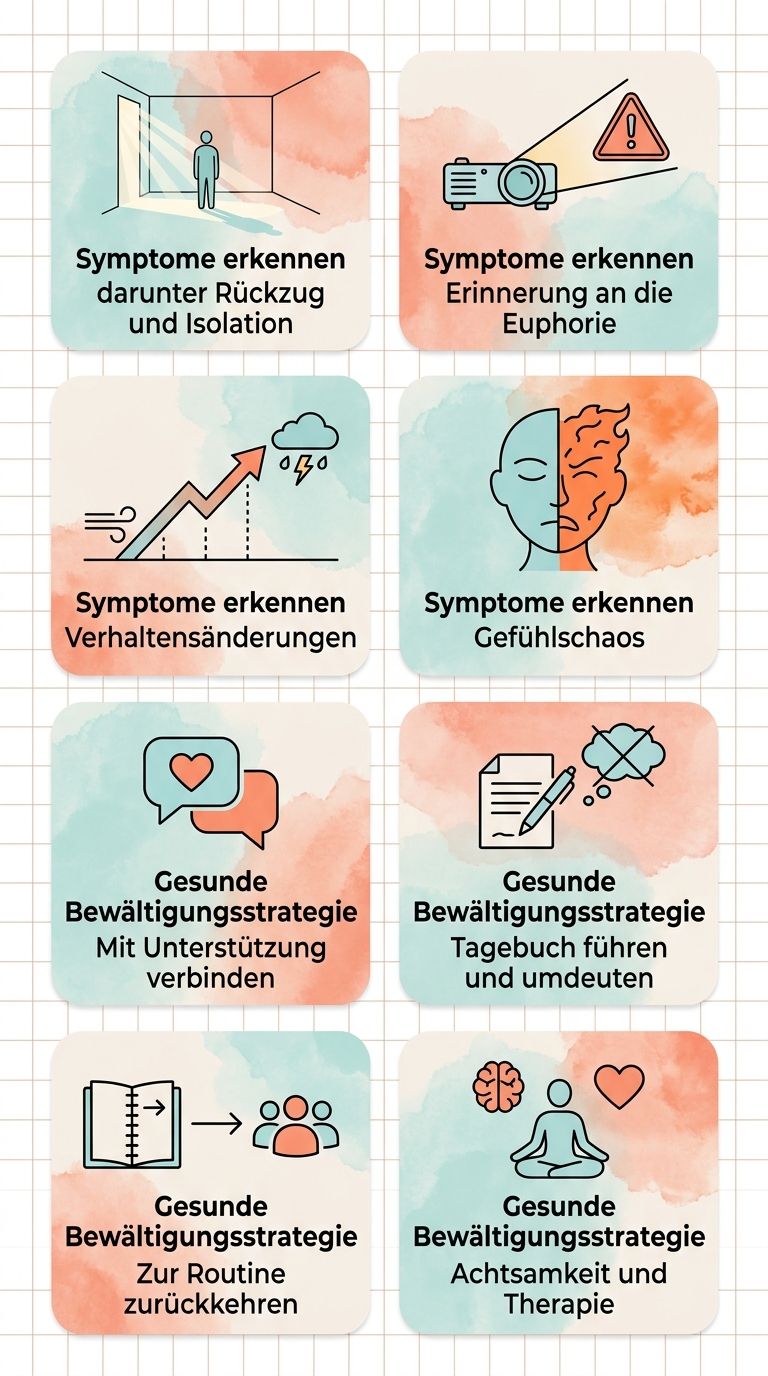
Erste Anzeichen eines Rückfalls erkennen und gesunde Bewältigungsstrategien anwenden.
Turning awareness into action starts with a personalized prevention plan.
Building a Personalized Relapse Prevention Plan: Your Step-by-Step Toolkit
A personalized relapse prevention plan transforms awareness into concrete action. Begin by listing high-risk people, places, and things. Then build a support network — a sponsor, family members, recovery peers, and alumni events keep you rooted. Grounding techniques like deep breathing and the 5-4-3-2-1 exercise anchor you in the present when cravings hit. Structure daily routines for meals, exercise, therapy, and leisure to reduce idle time and reinforce stability. Holistic practices — mindfulness, nutrition, stress management — address whole-person wellness. We believe in treating the whole person.
When these strategies are paired with evidence-based treatment such as PHP, IOP, or MAT, addiction recovery success rates by treatment type consistently show improved outcomes. Our addiction treatment in the Lehigh Valley and intensive outpatient program in Easton, PA provide the professional layer your prevention plan needs. Your plan grows with you — adjust it as you heal, and reach out anytime to review it or verify your insurance coverage.
You are not alone and this is not the end of your story. With the right tools and support, you can heal, grow, connect, and live fully. This content is for informational purposes and does not substitute for professional medical advice. Results may vary; services and outcomes are provided “as is” and not guaranteed.
Whole-Person Care: How Integrated Treatment Reshapes 2026 Relapse Trends
As we review addiction relapse statistics 2026, the data continue to show that without comprehensive support, many individuals face high rates of return to substance use. These 2026 relapse trends underscore the need for a different approach—one that goes beyond treating addiction in isolation. This is where whole-person care changes the equation, bringing behavioral health, primary care, and medication-assisted treatment together to drive better relapse prevention outcomes.
How Integrated Care Is Changing the Narrative on Relapse Prevention
According to the Substance Abuse and Mental Health Services Administration (SAMHSA), coordinating behavioral health, primary care, and medication-assisted treatment improves treatment retention and lowers relapse risk. Integrated care outcomes from the past year confirm that when a single team addresses mental health, physical health, and addiction simultaneously, the fragmented gaps that often lead to relapse are closed. Dual diagnosis treatment plays a central role: by treating co-occurring depression, anxiety, or trauma along with substance use in one coordinated plan, clients experience fewer early setbacks and higher rates of continued recovery.
| Domain | Traditional Fragmented Care | Integrated Whole-Person Care |
|---|---|---|
| Approach | Addiction treated in isolation | Addiction + mental health + physical health addressed together |
| Therapies | CBT or counseling alone | Evidence-based + holistic (CBT, trauma, yoga) — multiple modalities combined |
| Aftercare | Referral-based, disconnected | Structured alumni & family support — continuum of care |
| Dual Diagnosis | Often untreated/separate | Integrated psychiatric & behavioral care — medication management, therapy |
By addressing addiction, mental health, and physical health under one roof, this integrated model removes the fragmentation that fuels relapse and creates a seamless continuum that supports lasting wellness.
The Holistic Difference: Treating Mind, Body, and Spirit
At Recovery Cove, our holistic approach pairs evidence-based therapies like CBT with trauma therapy, yoga, mindfulness, and stress management. We believe in treating the whole person—mind, body, and spirit—because lasting recovery requires more than just addressing the substance use itself. While addiction recovery success rates by treatment type vary and no outcome is guaranteed, research demonstrates that integrated models that treat co-occurring conditions alongside substance use tend to improve long-term abstinence and relapse prevention outcomes. Our program in Easton, PA, brings these modalities together so that clients in Allentown, Bethlehem, and across the Lehigh Valley can heal on every level.
Advanced Strategies for Sustained Sobriety in 2026 and Beyond
Looking ahead, sustained sobriety depends on a web of support that extends beyond the therapy room. Recognizing early warning signs of relapse in recovery can make the difference between a setback and sustained progress. Common signs to watch for include:
- Withdrawing from support systems
- Skipping therapy or 12-step meetings
- Rising stress and unresolved emotional triggers
- Noticeable mood shifts or increased isolation
To keep those warning signs in check, we combine virtual care and digital health tools with active family involvement, peer support, and a structured alumni network. These forward-looking strategies transform recovery into a lifelong, connected journey—one that continues long after formal programming ends. Our virtual services offer flexible access for those in the Lehigh Valley and beyond, while family education and alumni events strengthen the community that surrounds each individual.
Results may vary. Consult a healthcare professional for diagnosis and treatment recommendations. Information on this site is not a substitute for professional medical advice and services are provided “as is” and not guaranteed. Putting this approach into practice starts with finding the right level of care—our flexible outpatient programs in Easton, PA, including PHP, IOP, and evening options, make it possible to receive comprehensive support while maintaining your daily responsibilities. Heal. Grow. Connect. Live. You are not alone and this is not the end of your story.
Frequently Asked Questions About Relapse Statistics and Recovery in 2026
You are not alone and this is not the end of your story. Here are answers to common questions about 2026 relapse statistics, early warning signs, and recovery success rates.
What do addiction relapse statistics 2026 show? Relapse is common and part of the recovery process. National data shows many individuals experience setbacks, and 2026 relapse rates are consistent with previous years. Recovery is a journey, not a failure.
What are early warning signs of relapse in recovery? Warning signs include withdrawing from support, increased stress, and mood changes. Learn more about addiction relapse triggers and how to manage them.
What are addiction recovery success rates by treatment type? Success varies by treatment type. Evidence-based methods like CBT, MAT, and structured outpatient care can support recovery, but individual factors matter most.
Heal. Grow. Connect. Live. We’re here to help you take the next step.
Results may vary. Consult a healthcare professional for diagnosis and treatment recommendations.
Start Your Recovery Today
Recovery Is Possible: Take the Next Step With Recovery Cove
While addiction relapse statistics 2026 draw attention, evidence-based, whole-person care can change the outlook. At Recovery Cove, we believe in treating the whole person — you are not alone and this is not the end of your story. Learning to recognize the early warning signs of relapse in recovery is part of the journey we support, and combining evidence-based treatment types can improve success rates. Our team is available to residents in the Lehigh Valley and across Easton, PA, 24/7; call 484-549-2683 for a confidential, no-pressure conversation. Recovery is a journey, not a destination — reaching out is the first step.
Heal. Grow. Connect. Live.
Call Recovery Cove Today
You don’t have to face recovery alone. Take the first step toward professional help by calling 484-549-2683 or visiting recoverycovepa.com. We offer transparent guidance on insurance and payment options so you can focus on healing. Remember, recovery is a journey, not a destination, and we’re here to walk with you every step of the way. Results may vary; information on this site is not a substitute for professional medical advice; consult a healthcare professional for diagnosis and treatment recommendations; services and outcomes are provided “as is” and not guaranteed.





